

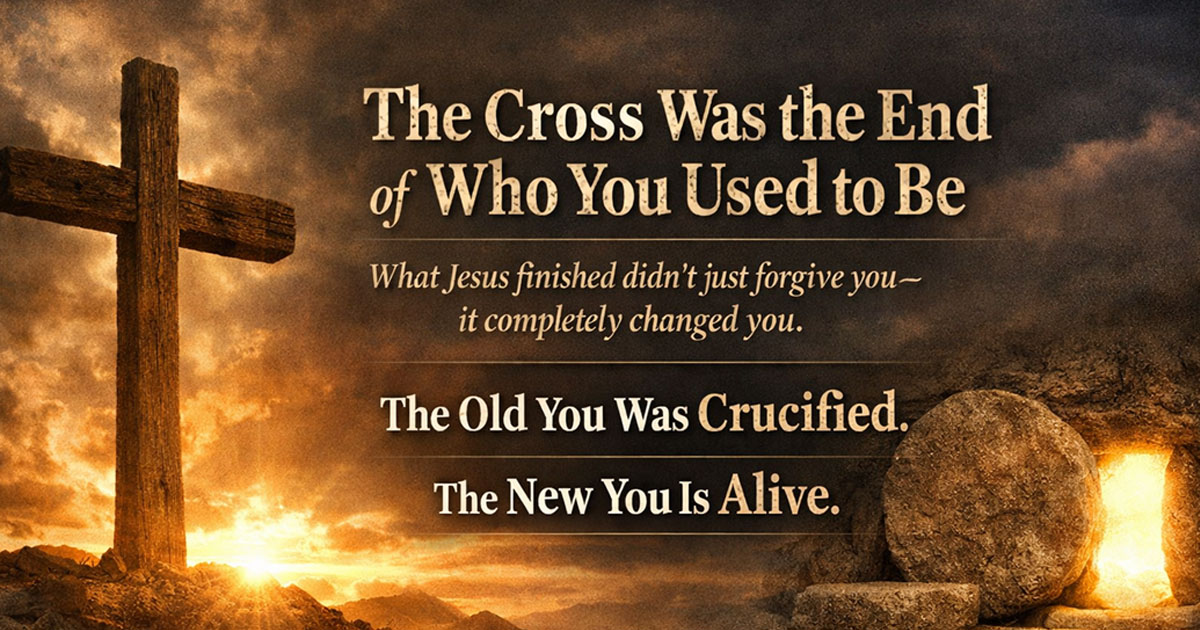
What Jesus finished didn’t just save you—it fundamentally changed you
Romans 6:6 (NLT) tells us, “We know that our old sinful selves were crucified with Christ so that sin might lose its power in our lives. We are no longer slaves to sin.” The cross was something Jesus endured, and it was something you were included in. This wasn’t a distant act of love meant to inspire you from afar; it was a spiritual event that involved you directly. Your old identity—the one shaped by sin, fear, wounds, survival patterns, and everything that kept pulling you out of alignment with God—was brought into that moment and dealt with there. God didn’t design salvation to manage the old version of you or make it slightly better. He designed it to bring that version to an end, once and for all.
You’re not called to manage what God already put to death
And this is where many believers sometimes struggle, even while loving Jesus deeply. We spend so much time trying to correct behaviors, wrestle down patterns, and negotiate with thoughts that feel familiar, not realizing we’re investing energy into something God has already addressed at the root. Galatians 2:20 (NLT) says, “My old self has been crucified with Christ. It is no longer I who live, but Christ lives in me. So I live in this earthly body by trusting in the Son of God, who loved me and gave himself for me.” Scripture makes it clear that you were crucified with Christ, which means your life is no longer sourced from who you used to be, but from Him. That changes the entire posture of how you walk this out.
The cross established a finished work, not an ongoing negotiation. It was never about behavior modification—it was about identity transformation. When we miss that, we live as if change depends on our effort instead of His finished work, and that keeps us cycling through frustration instead of walking in freedom.
When we approach our lives as if we still need to fix what God has already dealt with, we stay locked in cycles that Christ already broke. There is a difference between trying to become new and realizing you already are. One keeps you striving. The other settles you into truth and teaches you how to live from it.
The cross was an execution, not an adjustment
The cross was about more than forgiveness—it was about execution. The execution of the version of you that could never fully agree with God, never fully rest in His truth, and never consistently reflect His nature. That version of you wasn’t improved or upgraded—it was crucified with Christ. And if we don’t understand that, we will keep going back, trying to revive what heaven already put to death. We’ll continue to carry mindsets and identities that no longer belong to us. That’s not what our Heavenly Father wants.
The life Jesus secured for you cannot be poured into an old way of thinking, an old identity, or old patterns that were already brought to an end at the cross. He plainly tells us in Luke 5:37–38 (NLT), “And no one puts new wine into old wineskins. For the new wine would burst the wineskins, spilling the wine and ruining the skins. New wine must be stored in new wineskins.” You can’t carry old lies into a new identity, because the life you’ve been given in Christ doesn’t have room for what He already removed. The more we see this clearly, the less we strive to fix ourselves and the more we begin to live from what Jesus has already secured.
What God has placed within you through Christ will not settle into who you used to be—it requires the newness He already established.
What died with Christ cannot define you anymore
When Jesus went to the cross, He didn’t just carry your sin—He carried the version of you that was bound to it. And when He rose, He didn’t just leave the grave behind—He made it possible for you to walk in a completely new life. Colossians 3:3 (NLT) says, “For you died to this life, and your real life is hidden with Christ in God.” This is why holding onto old labels, old shame, and old internal narratives feels so exhausting, because you’re trying to carry something that no longer has life in it.
At some point, we have to agree with what God has already done. Not emotionally first, but spiritually. We have to let His truth lead, even when our feelings lag behind. Because freedom doesn’t come from feeling new—it comes from believing what He said about who you are now, and choosing to live from that place.
We should all be so incredibly thankful to our Heavenly Father for the sacrifice and resurrection of Jesus Christ. Through Him, what once held us down has been brought to an end, and a new life has been firmly established. Because of His love, we are no longer defined by who we were, but anchored in who He has made us to be. ■
Scripture quotations marked (NLT) are taken from the Holy Bible, New Living Translation, copyright © 1996. Used by permission of Tyndale House Publishers, Inc., Wheaton, Illinois 60189. All rights reserved.
“The Cross Was the End of Who You Used to Be”, written by Reverend Fran Mack, edited by Kim Times, for Sundie Morning Sistas ©2026. All rights reserved. All done to the glory of God through Jesus Christ, our Lord! SMS is dedicated to encouraging and inspiring Christian Women to live boldly through God’s Word.

Leave a Reply